LegalShield IDShield Explained: What It Covers and How Associates Can Pitch It

LegalShield IDShield Explained: What It Covers and How Associates Can Pitch It

A client tells you her email was in a data breach last month and she has no idea what to do next. If you can only talk about wills and traffic tickets, you just missed the easiest conversation of your week.

LegalShield IDShield is the product many associates mention last, even though almost every household understands the problem it solves. In this guide you will learn what IDShield covers, who needs it most, and how to pitch it in plain language without leaning on fear.


What LegalShield IDShield Actually Does

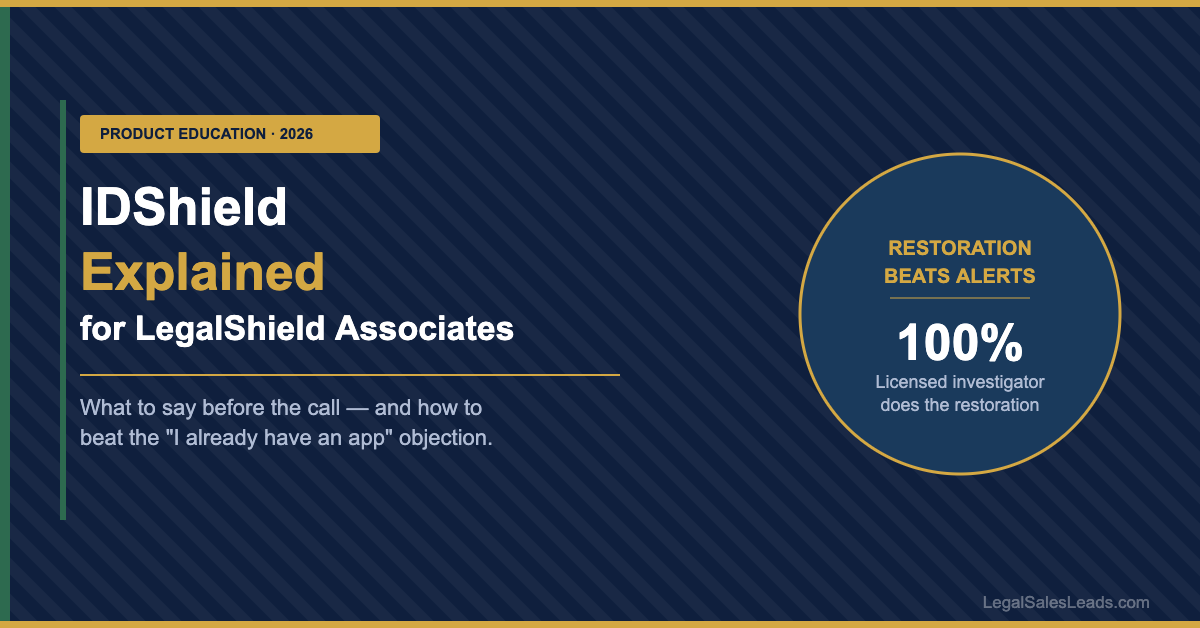
IDShield is the identity theft protection service offered alongside the LegalShield legal plans. It has two jobs: monitoring your client’s personal information for signs of misuse, and restoration if their identity is compromised. Restoration is handled by licensed private investigators who work the case on the member’s behalf, so the client is not left on hold with banks and credit bureaus alone.

The distinction matters when you pitch. Monitoring is the early warning, and restoration is the cleanup. Most prospects only picture the second, so lead with the first.

Monitoring versus restoration

Feature Without IDShield With IDShield
Spotting misuse Client notices a strange charge, maybe months later Ongoing monitoring flags suspicious activity
Credit and identity alerts Manual checks, if the client remembers Alerts sent to the member
If identity is stolen Client calls banks and bureaus alone Licensed investigators work the case
Cost of getting help Hours of personal time Included in the membership

Always confirm current features and plan options in your official LegalShield materials before quoting them. Details change, and accuracy protects your credibility.


Who Needs IDShield Most

Every adult has exposure, but some leads respond faster because the risk is already personal to them. Start with these groups when you work your lead list.

  • Parents with children. They worry about a child’s information being misused years before the child ever applies for credit.
  • Recent breach victims. Anyone who got a breach notice letter already believes the threat is real, so skip the education and go straight to the solution.
  • Small business owners. Their personal and business finances overlap, which makes one stolen identity a bigger problem.
  • Older relatives. Adult children often buy protection for aging parents who are common scam targets.

How to Pitch LegalShield IDShield Without Scare Tactics

Fear gets attention but it also gets a quick “I’ll think about it.” Calm, specific questions work better. Try an opener such as: “Has anyone in your family ever had to deal with a compromised account or a fraudulent charge?” Then stop talking and let the story come out.

A simple three-step flow

First, listen for the story and acknowledge how stressful it was. Second, contrast what they did on their own with what a monitoring and restoration service would have done for them. Third, bundle the idea with the legal plan: legal protection for disputes and identity protection for theft is one conversation about peace of mind, not two sales.

Key Insight

Prospects rarely say no to protection. They say no to confusion. If you can explain monitoring and restoration in two sentences, you have already done most of the selling.


Handling the Common LegalShield IDShield Objections

“My bank already watches my account.” Agree, then clarify. Banks watch their own accounts, not your client’s whole identity across credit files, new accounts opened in their name, and personal data circulating online. Monitoring covers the gaps between institutions.

“It has never happened to me.” That is the point of protection. Compare it to insurance: nobody buys it planning to use it, and the value is knowing a trained team is ready if something goes wrong.

“I can’t afford another subscription.” Reframe the cost against the hours and stress of repairing a stolen identity alone, then offer to review the plan options that fit their household. Never pressure; a clear comparison is enough.


Which Leads Work Best for IDShield

Fresh, opt-in leads who recently asked about legal protection are usually the warmest, because they are already thinking about risk. Speed matters here as well: call while the request is still on their mind, mention IDShield as part of the full picture, and let their response guide how much detail to offer.

Lead Type Best Opening Angle IDShield Fit
Family leads Protecting kids and household accounts Strong
Small business leads Separating business risk from personal risk Strong
Commercial driver leads Legal coverage first, identity second Moderate

IDShield Pitch Checklist

  1. Explain both halves — monitoring is the warning, restoration is the cleanup.
  2. Ask before you tell — get the client’s own story first.
  3. Match the lead — parents, owners and breach victims respond fastest.
  4. Bundle it — present identity protection alongside the legal plan.
  5. Verify details — quote only what your official materials confirm.

Start Conversations That Open the IDShield Door

Fresh, exclusive opt-in leads give you people who are already thinking about protection. Pick a package and start dialing today.
View Lead Packages

LegalShield Family Legal Plan Explained: Benefits, Use Cases and How to Pitch It

LegalShield Family Legal Plan Explained: Benefits, Use Cases and How to Pitch It

A young father tells you, “We can’t afford a lawyer, so we just hope nothing goes wrong.” Ninety seconds later he is asking what happens if his landlord sends a notice. That is the moment the family plan sells itself.

The LegalShield family legal plan is the membership most associates sell first, and the one most prospects misunderstand. They hear “legal plan” and picture a courtroom. What they actually need to hear is that a household gets a law firm on call for the everyday problems that cost real money: a lease dispute, a surprise bill, a will that was never written, a traffic ticket. This guide breaks down what the plan is built to do, who it fits, and how to explain it in plain language. Plan details vary by state and plan level, so always confirm specifics against current LegalShield materials before you promise anything.


What the LegalShield Family Legal Plan Actually Does

At its core, the plan gives a member access to a provider law firm in their state for covered matters, for a flat monthly membership instead of hourly billing. The pitch is not “we win cases.” It is “you can call a lawyer before a small problem becomes an expensive one.”

Prospects tend to respond to four buckets, so organize your explanation around them:

  • Advice and consultation. Members can call about covered legal questions without watching a clock.
  • Document help. Wills and other document review or preparation support, which is the easiest benefit for a parent to picture.
  • Contract and lease review. A second set of eyes before signing a lease, a car purchase or a service agreement.
  • Letters and calls on their behalf. Sometimes a letter on law firm letterhead resolves a billing or landlord problem fast.

Lead with a situation, not a feature list. A prospect who pictures their own lease or their own will stays on the phone. A prospect who hears a benefit list reaches for the “I’ll think about it” objection.


Who the Family Legal Plan Fits Best

The best prospects for a family legal plan share one trait: life has recently become more complicated. Think new baby, new home or rental, new job, a divorce settling, or an aging parent. Each event creates paperwork, and paperwork creates risk.

Best-fit household profiles

Young families with children and no will are the classic fit. Renters dealing with deposits and lease terms are a close second. Homeowners with a refinance or a contractor dispute respond well, as do adult children helping a parent sort out documents. When you read a lead’s profile before dialing, ask which of these events is probably driving their interest and open with that.

When to point them to a different plan

If the prospect runs their own business, the family plan is not the right conversation. Move to the small business plan. If their loudest worry is stolen identity rather than legal help, IDShield is the better opener, and many households end up with both. Matching the plan to the real concern protects your credibility and your retention.


Family Legal Plan vs. Paying a Lawyer Hourly

Prospects compare you to the only alternative they know: a local attorney. Give them a clean side-by-side so the value is visible. The figures below are illustrative ranges, not quotes, so frame them as “typical” when you talk.

Situation Hourly Attorney Family Legal Plan
Quick legal question Often billed by the hour or by a consultation fee Included for covered matters under the monthly membership
Lease or contract review Billed per document or per hour Covered review, subject to plan terms
Will preparation Flat fee or hourly, paid up front Preparation support included at the plan level that offers it
Cost predictability Varies with every call One flat monthly membership
Willingness to call early Many people wait until it is urgent Members are encouraged to call before problems grow

Key Insight

The real competitor is not another legal plan. It is the habit of ignoring legal problems until they are expensive. Sell the early phone call, and the monthly price stops being the main topic.


How to Pitch the LegalShield Family Legal Plan on the Call

Keep it to three moves. First, ask about a recent life event: “What prompted you to look into legal protection?” Second, tie one benefit to that event: a lease review for the renter, a will for the new parent. Third, make the monthly cost concrete by comparing it to a single hourly consultation they would otherwise pay for.

Then stop talking. Associates lose enrollments by explaining every benefit when the prospect already said yes with their questions. Fresh, exclusive leads help here because the prospect asked for information recently and remembers why. That is the advantage of working real-time, opt-in leads instead of aged lists: your opener lands on a live concern.

Family Plan Pitch Checklist

  1. Find the life event — new baby, lease, home, job or divorce.
  2. Pick one benefit — will, lease review or a letter on their behalf.
  3. Compare to hourly — one consultation can cost more than a month of membership.
  4. Confirm state details — never promise coverage you have not verified.
  5. Ask for the enrollment — then let them answer.

Talk to Families Who Are Ready to Listen

Exclusive, real-time LegalShield leads from people who asked for information. Pick a package and start dialing today.
View Lead Packages

LegalShield Commercial Driver Legal Plan Explained: What It Covers and How to Pitch It

LegalShield Commercial Driver Legal Plan Explained: What It Covers and How to Pitch It

Your lead is a long-haul driver who just got a speeding ticket in a work zone two states away. He isn’t worried about the fine. He’s worried about what the points do to his CDL, and that’s exactly where the Commercial Driver Legal Plan comes in.

If you want to sell the LegalShield Commercial Driver Legal Plan (often called CDLP) with confidence, you need to understand what it is, who needs it, and how to explain it in plain language. This guide breaks down the plan the way a driver thinks about it, so your next call sounds like a conversation and not a brochure. Always confirm the current coverage details and pricing in your LegalShield back office before you quote anything, since plan terms can change.


What the Commercial Driver Legal Plan Is Built For

A commercial driver’s license is a livelihood. For most CDL holders, a single moving violation can mean higher insurance costs, a hit to their driving record, and in a worst case a suspended license and lost income. A standard personal legal plan was never designed around that risk. The CDLP is positioned for drivers whose job depends on a clean record.

In general terms, the plan gives members access to a provider law firm for matters connected to driving a commercial vehicle, such as certain traffic-related issues, license problems, and legal questions that come up on the job. Describe it as access to a lawyer when it matters, and let the member read the plan documents for the specifics. Never promise outcomes. You are selling access and peace of mind, not guaranteed results.

The core message for drivers: your license is your paycheck, and this plan puts a lawyer in your corner before a ticket turns into a career problem.


Who Is the Ideal CDLP Prospect?

Not every driver is the same buyer. Matching your pitch to the driver’s situation is the fastest way to move a CDLP lead from curious to enrolled.

Owner-Operators

Owner-operators carry the most financial exposure. They own the truck, run the business, and lose money every day they sit. For them, the pitch is about protecting the business, and it pairs naturally with a conversation about small business needs.

Company Drivers

Company drivers often worry that a violation will cost them the job. Your angle is personal protection: the employer’s lawyers protect the company, not the driver.

New CDL Holders

Newer drivers have the most to lose and the least experience. They respond well to a simple, low-pressure explanation of what to do and who to call when something goes wrong.

Driver Type Main Worry Your Lead Angle
Owner-operator Lost loads and lost income Protect the business and the license
Company driver Losing the job over a violation Personal protection the employer does not provide
New CDL holder Not knowing who to call A lawyer to call from day one

How to Pitch the Commercial Driver Legal Plan on the Phone

Truckers are busy, often on the road, and quick to spot a sales script. Keep the call short, direct, and respectful of their time.

  • Ask about their situation first. A question like “Have you ever had a violation that worried you about your license?” gets a real story and shows you where the need is.
  • Use the license-as-paycheck frame. Drivers instantly understand that framing, so you rarely need to explain the risk.
  • Offer to call back at a better time. If they are mid-route, set a specific time. A scheduled callback beats a rushed pitch.
  • Keep the price conversation simple. Compare the monthly cost to a single day of lost driving income.

Key Insight

CDL drivers rarely object to the idea of legal protection. They object to wasted time. Lead with relevance in your first sentence and the rest of the call gets easier.


Where CDLP Leads Fit Into Your Pipeline

Driver leads work best when they are fresh and when you reach them at times drivers can actually talk, which usually means early morning, evening, or during rest stops. Build that into your calling schedule and use text or voicemail follow-ups for the calls you miss. If you want a deeper look at sourcing, see our guide on how to get CDLP leads that actually convert.

CDLP Cheat Sheet

  1. Know the risk — a CDL is a livelihood, so violations carry real income consequences.
  2. Segment the driver — owner-operator, company driver, or new CDL holder each need a different angle.
  3. Sell access, not outcomes — never guarantee results and always point to the plan documents.
  4. Respect their time — be brief and schedule callbacks around their route.
  5. Verify details — confirm current coverage and pricing in your back office before quoting.

Ready to Talk to Drivers Who Need This Plan?

Get exclusive, opt-in leads delivered to you and start more conversations with people actively looking for legal protection.

View Lead Packages

IDShield Identity Theft Protection Explained: What Associates Need to Know Before the Call

IDShield Identity Theft Protection Explained: What Associates Need to Know Before the Call

A prospect tells you she already has a credit monitoring app and doesn’t need “another subscription.” Twenty minutes later she’s asking how fast IDShield can get a licensed investigator on the phone after her identity gets stolen — because credit monitoring told her something happened, but it can’t do anything about it.

That gap — between knowing something is wrong and having someone fix it — is the entire sales case for IDShield. Most leads have heard of identity theft protection. Almost none understand what separates a monitoring app from a full-service restoration plan, and that confusion is exactly where associates lose winnable calls. If you can’t explain the difference in under 90 seconds, you’re leaving commissions on the table every week.


What IDShield Actually Covers

IDShield is built around three pillars: monitoring, alerts, and full-service restoration. The monitoring piece watches credit files, dark web marketplaces, social media accounts, court and criminal records, and financial accounts for suspicious activity. The alerts piece pushes real-time notifications to the member’s phone or email the moment something changes. But the piece that actually closes deals is restoration — a licensed private investigator is assigned to the member’s case and does the work of reversing fraudulent charges, disputing accounts, and restoring the member’s identity, regardless of how long it takes or how many hours it requires.

That last detail matters more than any feature on the list. Most free or bank-provided monitoring tools stop at the alert. They tell you something is wrong and then hand you a stack of phone numbers to call yourself. IDShield’s licensed investigators do the calling, the paperwork, and the follow-up — which is the single biggest differentiator you should be leading with on every call.

Individual vs. Family Plans

IDShield offers coverage for a single adult or an entire family, including minor children. The family plan is often the easier sell once a prospect has kids, because child identity theft frequently goes undetected for years — a minor’s Social Security number can be used to open credit lines that nobody checks until the child applies for their first credit card or student loan. Framing the family plan around that blind spot, rather than generic “protect your family” language, tends to land harder with parents.


IDShield vs. Free Monitoring Apps

Almost every prospect you call believes they already have some form of protection, whether it’s a bank alert, a free credit score app, or a monitoring feature bundled into another subscription. The comparison below is the fastest way to show the gap without sounding like you’re bashing a competitor — you’re simply describing what each option actually does.

Feature Free / Bank Monitoring IDShield
Credit monitoring Usually one bureau Multi-bureau + dark web scan
Restoration help Self-service instructions Licensed investigator does the work
Coverage limit Often capped or none Guaranteed until fully resolved
Social & reputation monitoring Not included Included
Child protection Rarely offered Available on family plans

Most consumers don’t realize identity theft victims spend an average of dozens of hours resolving fraudulent accounts on their own. That hours-saved argument, not the monitoring feature list, is usually what moves a hesitant prospect to yes.


How to Position IDShield on the Call

Don’t open with features. Open with the scenario the lead is already worried about. Most people who requested information on identity protection did so because of a news story, a data breach notification, or a friend’s bad experience — not because they woke up wanting a new subscription. Ask what prompted their interest before you explain anything, then map the plan directly to that trigger.

The Bundle Opportunity

IDShield pairs naturally with a LegalShield legal plan, and leads who came in through a legal-plan funnel are often receptive to adding identity protection once they understand it’s a separate risk with a separate solution. Framing it as “the two things most likely to blindside a family financially” — an unexpected legal issue and identity theft — tends to outperform pitching them as unrelated add-ons.

  • Lead with the trigger, not the features. Ask what prompted the request before pitching anything.
  • Emphasize restoration over monitoring. Alerts are common; a licensed investigator doing the work is not.
  • Use the family angle for parents. Child identity theft is an underrated close.
  • Bundle with legal plans when relevant. Position both as protection against different blindsides.

Key Insight

The close isn’t “do you want identity protection.” It’s “do you want someone else to do the work of fixing it when it happens.” That reframe is what separates associates who sell IDShield from those who just describe it.

Quick Recap

  1. Restoration beats monitoring — lead with the licensed investigator, not the alert feature.
  2. Family plans sell on the child angle — parents rarely know minors are at risk.
  3. Bundle strategically — pair with legal plans as two distinct forms of protection.
  4. Ask before you pitch — the trigger behind the lead request is your strongest opening line.

Ready to Talk to Leads Who Already Want This?

Stop guessing which prospects are worth the callback. Get exclusive, opt-in LegalShield and IDShield leads built for associates who close.

View Lead Packages

LegalShield Small Business Plan Benefits Explained: What Associates Need to Know

LegalShield Small Business Plan Benefits Explained: What Associates Need to Know

A prospect running a five-person landscaping company just asked you, “Why would I pay monthly for legal help I might never use?” If you fumbled that answer last week, this post fixes it for next time.

The LegalShield Small Business Plan is one of the most misunderstood products in the entire portfolio — not because it’s complicated, but because most associates pitch it like a personal plan with a bigger price tag. It isn’t. Understanding the LegalShield small business plan benefits in detail is what separates associates who close business owners on the first call from associates who get a polite “I’ll think about it.”


What the Small Business Plan Actually Covers

Unlike the personal and family plans, the small business plan is built around the recurring legal touchpoints a business owner hits every quarter: contract review, debt collection letters, employee handbook questions, and vendor disputes. Every plan level includes unlimited attorney consultation on new business matters and document review up to a set page count — meaning an owner can send over a lease, a supplier agreement, or an independent contractor contract and get it reviewed before signing, not after a dispute starts.

The Debt Collection Letter Feature

This is the single most underused selling point. Any business owner who has ever chased a client for an unpaid invoice already understands the value of a law firm letterhead landing in a client’s inbox. Under the plan, provider law firms will send collection letters and make collection calls on the business’s behalf — something that would otherwise cost $150–$300 per letter from a solo attorney.

Small businesses lose an estimated 5% of annual revenue to uncollected invoices, according to industry receivables data. A single recovered invoice often covers a full year of plan membership.


How the Plan Compares to Hiring an Attorney Directly

This is the comparison every prospect is silently making, so make it for them before they do the math wrong.

Need Hourly Attorney LegalShield Small Business Plan
Contract review $200–$400 per contract Included, unlimited requests
Collection letter $150–$300 each Included
Phone consultation $250+ per hour Unlimited, no hourly fee
Monthly cost Varies, often a retainer Flat monthly rate

Why “Flat Rate” Is the Real Hook

Business owners don’t fear legal problems — they fear unpredictable legal bills. A flat monthly rate converts an unbounded risk into a fixed, budgetable line item. When you frame the plan this way instead of as “legal insurance,” owners stop comparing it to a service they’ve never bought and start comparing it to a bill they already understand.


Who to Pitch This Plan To

Not every lead on your list is a fit. The strongest small business plan prospects share three traits: they have employees (which means HR and handbook exposure), they extend credit or invoice terms to clients (collection risk), and they sign contracts regularly (leases, vendor agreements, subcontractor terms). Landscapers, contractors, salons, small retailers, and independent consultants with client contracts all check these boxes.

Key Insight

Lead with the pain point the owner already has — a slow-paying client or an unreviewed contract — not with a list of plan features. Features close associates. Pain points close owners.

Objection: “My Accountant Handles This”

Accountants handle numbers, not liability. Reframe the objection by asking who reviews their vendor contracts or drafts their employee handbook — usually nobody, until something goes wrong. That gap is exactly what the plan closes.


Working Small Business Leads Effectively

Small business leads convert best when contacted within the first hour and when the first conversation focuses on their specific industry risk rather than a generic script. Ask what kind of contracts they sign monthly before you mention price — the answer usually hands you the exact benefit to lead with.

  • Ask about contracts first. It surfaces the plan’s most relevant feature immediately.
  • Quantify the collection letter value. One recovered invoice often pays for a year.
  • Reframe cost as predictability. Flat monthly rate versus unpredictable hourly billing.
  • Target owners with employees. HR exposure is a strong secondary hook.

Quick Recap

  1. Lead with pain, not features — unpaid invoices and unreviewed contracts sell the plan faster than a benefits list.
  2. Quantify the savings — compare the flat rate to real hourly attorney costs the owner already fears.
  3. Target the right owners — businesses with employees, contracts, and client invoicing are the strongest fits.
  4. Work leads fast — first-hour contact with an industry-specific opener converts best.

Ready to Pitch Business Owners Who Actually Fit This Plan?

Get exclusive, opt-in leads matched to the small business plan and stop guessing who’s a fit.

View Lead Packages

What’s Included in the LegalShield Small Business Legal Plan? A Guide for Associates

What’s Included in the LegalShield Small Business Legal Plan? A Guide for Associates

A prospect running a five-person landscaping company tells you, “I already have a lawyer I call when something breaks.” Then you ask when he last reviewed a contract before signing it, and he goes quiet. That gap — reactive legal help versus proactive coverage — is exactly what the LegalShield small business legal plan is built to close, and it’s the easiest small-business conversation you’ll ever have once you know what’s actually inside the plan.

Most associates can recite the personal plan pitch in their sleep, but stumble when a prospect who owns a business asks, “What do I actually get?” This guide breaks down exactly what’s included in the LegalShield small business legal plan, how to explain each piece in plain language, and how it stacks up against paying an attorney hourly.


The Six Core Coverage Areas

The LegalShield small business legal plan is built around the situations that come up constantly for owners — not rare, catastrophic events. That’s the pitch: this is a plan for everyday legal exposure.

1. Contract & Document Review

Vendor agreements, leases, employment offers, and client contracts get reviewed by a provider law firm before the owner signs. This is the single biggest value driver — most small-business legal problems trace back to a contract nobody read closely.

2. Debt Collection Letters

Unpaid invoices are a chronic pain point. The plan includes attorney-drafted collection letters on law firm letterhead — which alone resolves a large share of past-due accounts without ever going to court.

3. Unlimited Attorney Consultations

Owners can call their dedicated provider law firm on business legal questions — HR issues, vendor disputes, lease terms — without a meter running. This is what replaces the “I’ll just call my lawyer” instinct with “it’s already covered.”

4. Trial Defense & Business Litigation Assistance

If the business is sued in a covered matter, the plan provides trial defense support so the owner isn’t facing legal fees alone at the worst possible moment.

5. Employment & HR Document Support

Employee handbooks, offer letters, and termination documentation get legal review — critical for owners hiring their first employees without an HR department behind them.

6. Registered Agent & Business Formation Guidance

For owners still operating as sole proprietors, the plan supports entity formation guidance — a natural upsell conversation into liability protection.

Most small-business owners have never had a contract reviewed before signing it. That single benefit is usually enough to justify the plan on its own — everything else is upside.


LegalShield Small Business Plan vs. Paying an Attorney Hourly

When a prospect pushes back with “I’ll just call my attorney if something comes up,” this comparison ends the conversation quickly.

Need Hourly Attorney LegalShield Business Plan
Contract review $200–$500 per document Included, unlimited
Collection letter $150–$300 each Included
Quick phone consult $75–$150 per call Included, unlimited
Monthly cost Varies, unpredictable Flat, predictable

How to Pitch It in Under Two Minutes

Don’t lead with the feature list. Lead with the question that exposes the gap: “When’s the last time an attorney reviewed a contract before you signed it?” Then walk through contract review, collection letters, and unlimited consultations in that order — those three benefits close more small-business plans than the entire remaining feature set combined.

Key Insight

Owners don’t buy the small business plan because they’re worried about lawsuits. They buy it because contract review and collection letters solve problems they’re dealing with this month.

Who to Target

This plan converts best with owners who already feel the pain: contractors chasing unpaid invoices, service businesses signing new vendor contracts, and anyone who just hired their first employee. Filter your leads for these signals before you dial, and your close rate on business plans climbs fast.

  • Contractors and trades. Constant contract signing and slow-paying clients.
  • New employers. First hire means first HR documents and first compliance exposure.
  • Sole proprietors scaling up. Formation guidance opens a natural upgrade conversation.

Quick Recap

  1. Six core benefits — contract review, collection letters, unlimited consults, trial defense, HR support, and formation guidance.
  2. Lead with pain, not features — ask about the last contract they signed unreviewed.
  3. Target the right owners — contractors, new employers, and scaling sole proprietors convert fastest.

Want More Small-Business Owners on Your Call List?

Get exclusive, opt-in leads filtered for the associates who need them most — no shared leads, no bidding wars.

View Lead Packages

The LegalShield Family Legal Plan Explained: What It Covers and How to Sell It

The LegalShield Family Legal Plan Explained: What It Covers and How to Sell It

A prospect on your call last week said, “I just need something for if my landlord tries to screw me over, or if I get a speeding ticket.” That one sentence is basically the entire pitch for the LegalShield Family Legal Plan — you just have to know how to say it back to them.

The LegalShield Family Legal Plan is the plan most associates sell the most and explain the worst. It covers a wide range of everyday legal situations — traffic tickets, landlord disputes, contract reviews, family law consultations, will preparation — but new associates often either underexplain it (“it’s like legal insurance”) or overexplain it (reading the full benefits list like a terms-of-service document). Neither approach closes leads. What closes leads is mapping the plan’s coverage directly to the specific worry the prospect already told you about.


What the LegalShield Family Legal Plan Actually Covers

At its core, the Family Legal Plan gives members access to a dedicated provider law firm for unlimited legal advice by phone on personal, non-business matters. That includes document preparation and review (leases, contracts, warranty claims), trial defense for covered civil matters, traffic-related legal defense, letters and phone calls made on the member’s behalf, and access to will preparation for the member and spouse. Members also get 24/7 emergency legal access for situations like an arrest or a business emergency involving personal liability.

The Coverage Gap Most Associates Miss

The plan does not cover matters that already existed before enrollment, business-related legal issues (that’s what the Small Business Plan is for), or lawsuits against LegalShield or its provider firms. If a lead has an active lawsuit already in motion, be upfront that the plan applies going forward, not retroactively — this single disclosure builds more trust than any part of the pitch.


LegalShield Family Legal Plan vs. Hiring an Attorney Directly

The comparison that actually lands with price-sensitive leads isn’t LegalShield versus “nothing” — it’s LegalShield versus what they’d pay an attorney out of pocket for the exact same situations. Most consumers have no idea a single lease review or demand letter from a private attorney can run $200–$500.

Situation Private Attorney LegalShield Family Plan
Contract or lease review $150–$400 per document Included, unlimited
Will preparation $300–$1,000+ Included for member + spouse
Traffic ticket defense $150–$300 per ticket Included
Phone consultation with a licensed attorney $50–$150 per call Unlimited, no charge
Monthly cost Billed hourly, no cap Flat monthly membership

Most leads have used exactly one of these services in the past two years — a lease review, a will, or a traffic ticket. Ask which one on the call. Their answer tells you exactly which benefit to lead with.


A Sales Script for Explaining the Family Legal Plan

Skip the benefits list. Use a three-part script tied to what the lead already told you they’re worried about:

1. Mirror the Concern

“You mentioned [landlord issue / speeding ticket / needing a will]. That’s actually one of the most common reasons people join this plan.”

2. Name the Specific Benefit

“With the Family Legal Plan, you’d call the provider law firm directly, they’d review the lease or handle the traffic defense, and it’s already covered — no separate bill.”

3. Anchor the Price Against the Alternative

“A single visit to an attorney for that would likely cost more than a year of the plan — and this covers everything else that comes up too.”

Key Insight

Associates who tie the pitch to a benefit the lead already named close at a noticeably higher rate than those who recite the full plan brochure. Specificity, not completeness, is what sells.


Common Questions Leads Ask About the Family Legal Plan

  • “Does it cover my whole family?” The plan covers the member, spouse, and dependent children living at home — confirm household details early in the call so you quote the right plan tier.
  • “What if I need a lawyer in court?” Trial defense is included for covered civil matters; the provider firm represents the member rather than just giving advice.
  • “Is there a waiting period?” Coverage begins immediately for new matters after enrollment — make sure the lead understands pre-existing issues aren’t retroactively covered.
  • “Can I cancel anytime?” Yes — it’s a month-to-month membership, which removes a major objection for leads worried about being locked in.

Quick Recap

  1. Lead with the specific worry — not the full benefits list.
  2. Anchor price against a private attorney — one visit often costs more than a year of coverage.
  3. Disclose the pre-existing matter exclusion — it builds trust and prevents chargebacks later.
  4. Confirm household size — so you’re quoting the correct coverage from the start.

Spend Your Calls on Leads Who Already Want This

Exclusive, opt-in LegalShield leads mean fewer scripts wasted on people who’ve never heard of the plan.

View Lead Packages

The LegalShield CDLP Plan Explained: What Associates Need to Know

The LegalShield CDLP Plan Explained: What Associates Need to Know

A prospect mentions he drives a rig for a regional freight company, and the call almost ends there — until the associate remembers LegalShield has a plan built exactly for him. That’s the moment the LegalShield CDLP plan stops being a line item and starts being the reason the sale closes.

The LegalShield CDLP plan — short for Commercial Driver Legal Plan — is one of the most underused tools in an associate’s kit, mostly because reps don’t fully understand what it covers or who needs it. That’s a missed opportunity: there are more than 3.5 million truck drivers in the U.S. alone, and nearly all of them face a legal risk most personal plans were never designed to handle — moving violations, DOT citations, and CDL-specific hearings that can end a career overnight.

This guide breaks down what the LegalShield CDLP plan actually covers, how it differs from the standard personal legal plan, and how to position it so commercial drivers understand why it’s not optional — it’s protection for their livelihood.


What Is the LegalShield CDLP Plan?

The LegalShield CDLP plan is a specialized legal membership designed for commercial drivers — truckers, bus operators, and anyone whose income depends on holding a valid Commercial Driver’s License. Unlike the standard personal plan, which focuses on everyday legal needs like contracts, wills, and general consultations, the CDLP plan is built around the specific legal exposure that comes with driving for a living: traffic citations, DOT compliance issues, license points, and the hearings that can follow.

Who Needs a Commercial Driver Legal Plan

Any prospect who holds a CDL is a candidate — owner-operators, company drivers, delivery fleet employees, and even drivers in training. For this group, a single unresolved citation isn’t a $150 fine; it’s a potential loss of the license that pays their mortgage. That’s the framing that makes the LegalShield CDLP plan sell itself once a prospect understands it.


CDLP Plan vs. the Standard Personal Plan

Associates often default to pitching the standard personal plan because it’s the one they know best. But for a commercial driver, the coverage gap is significant. Here’s how the two compare on the issues that matter most to a CDL holder:

Coverage Area Standard Personal Plan CDLP Plan
Moving violation defense Limited, general traffic help Built specifically for CDL violations
DOT citation support Not included Included
License hearing representation Case-by-case, added cost Core benefit of the plan
Employment-related legal issues General employment consultation Tailored to driver employment disputes
Best fit for General consumers, families CDL holders, owner-operators, fleet drivers

A single serious moving violation can trigger a CDL suspension review. For a driver whose entire income depends on that license, the CDLP plan isn’t an upsell — it’s the plan that actually matches their risk.


How to Position the CDLP Plan on a Sales Call

Don’t lead with plan mechanics — lead with the driver’s biggest fear: losing the license that pays the bills. Ask what happens to their household if they’re parked for 30, 60, or 90 days waiting on a hearing. Once that risk is named out loud, walking through the LegalShield CDLP plan becomes a solution conversation instead of a features pitch.

Key Insight

Commercial drivers rarely shop on price the way personal-plan prospects do — they shop on relevance. A rep who can speak fluently about CDL points, DOT hearings, and log violations earns trust faster than one reciting a generic benefits sheet.

Common Objections and How to Answer Them

  • “My company handles that.” Most carriers cover accidents involving company equipment — not personal citations, license hearings, or DOT compliance issues tied to the driver individually.
  • “I’ve never had a ticket.” The CDLP plan isn’t priced against past history — it’s protection against the one incident that could take months of income away.
  • “Isn’t this the same as my regular plan?” Walk them through the comparison table above — the coverage gap on DOT and license-hearing support is the differentiator.

CDLP Plan: What Associates Should Remember

  1. It’s built for CDL holders — owner-operators, company drivers, and fleet employees are the target audience.
  2. The coverage gap is real — standard personal plans don’t address DOT citations or license hearings the way the CDLP plan does.
  3. Lead with the risk, not the plan — frame the conversation around income loss from a suspended license before walking through benefits.
  4. Objections usually come from confusion, not price resistance — most drivers assume their employer already covers this.
  5. The best CDLP prospects come from targeted leads — general consumer leads rarely convert as well as leads pre-filtered for commercial drivers.

Want Leads That Actually Fit the CDLP Plan?

Generic lead lists waste time on prospects who don’t need this plan. Get exclusive, filterable LegalShield leads built for the associates who sell it.

View Lead Packages

IDShield Identity Theft Protection: What It Covers and How to Sell It Fast

IDShield Identity Theft Protection: What It Covers and How to Sell It Fast

Your prospect just got a fraud alert text from their bank at 9pm — by the time you call them back the next morning, they’re primed to buy. That’s the exact moment IDShield identity theft protection sells itself, if you know how to explain it.

Most associates can recite the LegalShield pitch in their sleep, but IDShield identity theft protection gets glossed over as an add-on instead of the standalone close it actually is. Prospects already understand they’re at risk — data breaches make headlines every month — but they don’t know what real protection looks like versus the free credit alerts their bank already sends them. That gap is where you make the sale.


What Is IDShield Identity Theft Protection, Really?

IDShield is LegalShield’s identity monitoring and restoration plan. It watches for misuse of a member’s personal information across credit files, the dark web, court records, social media, and financial accounts, and — this is the part that closes deals — it pairs that monitoring with a licensed private investigator who does the actual restoration work if something goes wrong. That’s the single biggest differentiator from the free tools your prospects already have.

Free bank alerts tell someone their identity was stolen. IDShield fixes it. Leading with that distinction is the fastest way to move a lukewarm lead into a signed member.

Individual vs. Family Coverage

IDShield offers both individual and family plans, and the family tier covers minors — a detail worth surfacing early, since child identity theft often goes undetected for years because kids don’t check their credit. Parents who hear that stat almost always ask follow-up questions, which is your opening to walk through enrollment.


What’s Actually Included in the Plan

When a prospect asks “what am I paying for,” give them specifics, not marketing language. The plan includes:

  • Credit and identity monitoring. Continuous scanning of credit files, bank and retail accounts, and public records for suspicious activity.
  • Dark web and social media monitoring. Alerts if personal data or account credentials show up in breach dumps or on impersonation accounts.
  • Licensed investigator-led restoration. A dedicated investigator handles the paperwork, calls, and disputes if identity theft occurs — the member doesn’t do it alone.
  • Reimbursement coverage. Financial protection for costs tied directly to restoring a stolen identity.

Identity theft reports to the FTC have topped 1 million cases annually in recent years — and restoration without professional help commonly takes prospects well over 100 hours. That’s the pain point IDShield identity theft protection is built to remove.


IDShield vs. Free Monitoring Apps

Prospects will almost always mention a free app or bank alert as a reason to hesitate. Use this comparison to reframe the conversation around outcomes, not just alerts.

Feature Free Monitoring App IDShield
Monitoring scope Credit file only Credit, dark web, social, court records
Who fixes the problem The member, alone Licensed investigator
Family / minor coverage Rarely included Available on family plans
Financial reimbursement Not included Included

How to Position IDShield on a Sales Call

Don’t open with features — open with a question that surfaces the gap in what they already have.

The Three-Question Opener

Ask: “If your identity were stolen tomorrow, who would actually fix it? How many hours could you spend on hold with credit bureaus? And who’s watching your kids’ identities right now?” Most prospects have no answer, which is exactly the opening IDShield identity theft protection is designed to fill. Let the silence do the selling before you jump into plan details.

Key Insight

Leads who’ve recently experienced a breach notification, fraud alert, or lost wallet convert on IDShield significantly faster than cold prospects — because the pain is already top of mind. Filtering for recency of concern beats filtering for demographics alone.


Why IDShield Leads Convert Faster Than Cold Prospects

Cold outreach forces you to build urgency from scratch. A prospect who opted in after searching for identity protection already has it — your job is to translate that urgency into IDShield identity theft protection specifics instead of generic reassurance. That’s why associates working pre-qualified, opt-in leads consistently close identity protection plans faster than those working purchased contact lists or referrals with no expressed interest.

Quick Recap

  1. Lead with restoration, not monitoring — a licensed investigator is the real differentiator over free apps.
  2. Use the three-question opener to surface the coverage gap before pitching features.
  3. Highlight family/minor coverage for prospects with kids — it’s an underused hook.
  4. Prioritize opt-in, high-intent leads over cold lists for identity protection closes.

Ready to Work Warmer Leads?

Get exclusive, opt-in LegalShield and IDShield leads built for associates who want faster closes, not more cold calls.

View Lead Packages

The LegalShield Small Business Plan Explained: A Sales Script for Associates

The LegalShield Small Business Plan Explained: A Sales Script for Associates

A contractor lead tells you he “doesn’t need a lawyer, he’s never been sued.” Ten minutes later he mentions a client who’s refusing to pay a $6,000 invoice over a contract he wrote himself on a napkin. That’s the moment the LegalShield Small Business Plan sells itself — if you know how to explain it.

Most associates can pitch the personal legal plan in their sleep. The LegalShield Small Business Plan is a different conversation — the buyer is thinking about cash flow, liability, and contracts, not speeding tickets and wills. If you’re working leads who own a business, side hustle, or LLC, understanding this plan cold is the difference between a 10-minute close and a prospect who says “let me think about it” and never calls back.


What the LegalShield Small Business Plan Actually Covers

The LegalShield Small Business Plan gives owners access to a dedicated provider law firm for the everyday legal work that businesses generate constantly: contract review, collections letters, employment questions, and consultations on business decisions before they turn into disputes. It is not a substitute for litigation coverage — it’s designed to catch problems before they become expensive ones.

Core Legal Services Included

Depending on plan tier, business owners get unlimited attorney consultations on new legal matters, contract and document review (leases, vendor agreements, client contracts), debt collection letters sent on law firm letterhead, and a discounted hourly rate for services beyond the plan’s scope, like litigation or formation work. For a solo contractor or a five-person LLC, that collections letter alone often pays for a year of membership the first time it’s used.

A demand letter from a law firm resolves unpaid invoices far more often than a follow-up email from the business owner — and most small businesses have no fast, affordable way to send one without this plan.

Who the LegalShield Small Business Plan Is Built For

This plan isn’t a generic pitch for anyone with an LLC. It converts best with prospects who sign contracts, hire people, or deal with customer disputes as part of daily operations. That includes contractors and tradespeople, independent consultants, ecommerce sellers, restaurant and salon owners, and property managers or landlords with a handful of units. If a lead’s business touches any of those categories, the small business plan is a stronger fit than the personal plan alone.

Red Flags That Signal a Strong Fit

Listen for specific pain points during discovery calls: mentions of a client who hasn’t paid, a vendor contract they signed without reading closely, an employee dispute, or hesitation about firing someone because they’re “worried about getting sued.” Each of those is a direct entry point into explaining what the plan solves.


LegalShield Small Business Plan vs. Hiring a Traditional Business Attorney

The comparison prospects make in their head is “plan vs. no lawyer at all.” The comparison that actually closes deals is “plan vs. paying an attorney by the hour every time something comes up.”

Metric Hourly Business Attorney LegalShield Small Business Plan
Typical cost per contract review $150–$400 Included in monthly membership
Response time for questions Days, often billed for the call itself Same or next business day, unlimited
Collections/demand letters Billed separately, $200+ Included
Monthly cost predictability Unpredictable, invoice-based Flat monthly rate

How to Position the Small Business Plan on a Sales Call

Don’t open with “legal insurance” language — business owners tune it out because it sounds like something they’ll never use. Open with the specific friction points their business already has: unpaid invoices, contracts they didn’t write, or a hire that didn’t work out. Then frame the plan as the fix for that specific friction, not a hypothetical.

A Simple Framing Script

“Most of my clients who run a business don’t sign up because they’re afraid of getting sued — they sign up because they’re tired of chasing down invoices and reading contracts they don’t fully understand. The plan gives you a law firm on call for exactly that, for less than what one hour with an attorney costs.”

Key Insight

Business-owner leads convert faster when the pitch centers on a cash-flow problem they already have (unpaid invoices, contract disputes) rather than abstract legal risk they haven’t experienced yet.

This is also why lead quality matters more with the small business plan than almost any other product. A cold list of “business owners” wastes calls on prospects who don’t sign contracts or manage employees. Leads that are pre-qualified by business type and pain point — the kind built for LegalShield associates — get you to that invoice conversation on the first call instead of the fifth.

Quick Recap

  1. Know the core coverage — consultations, contract review, and collections letters are the selling points that matter most.
  2. Target the right business types — contractors, consultants, ecommerce sellers, and landlords convert best.
  3. Anchor against hourly attorney costs — the flat-rate comparison is the strongest close.
  4. Lead with their pain, not legal jargon — invoices and contracts sell better than “legal insurance.”
  5. Work qualified leads — pre-filtered business-owner leads shorten the path to close.

Ready to Talk to Business Owners Who Actually Need This Plan?

Get exclusive, pre-filtered leads built for LegalShield associates — no shared lists, no cold guesswork.

View Lead Packages

Disclaimer:

LegalSalesLeads.com is an independent marketing and lead-generation platform and is not affiliated with, endorsed by, or sponsored by LegalShield® or Pre-Paid Legal Services, Inc. (PPLSI). LegalShield® is a registered trademark of PPLSI. References to LegalShield are used solely to identify the intended audience for our services.